Decluttering to Get Ready for Spring

March 6th, 2018

At the end of every winter, I always get antsy for the warmer weather and sunshine that spring promises. I like to use this time in between the seasons to think about the changes I want to make in my life and home. The home can be a reflection of the mind, and if our environment is cluttered and chaotic, it can make it hard to slow down and relax. If you look around your home right now, chances are you will see many items that you seldom use or even think about.

These types of items are just taking up space and contributing to stagnant energy in your home, while making it difficult to find inspiration, motivation or peace.


Most people have some sort of ‘spring cleaning’ regimen that they follow every year. I like to start this process by getting rid of things I don’t need or use to help make space for new growth. Going through and purging first can make it easier when it comes down to really deep cleaning your home after winter, as you won’t have as much stuff to work around. With so many different decluttering methods out there, it can make the whole process seem a little daunting.

Try some of these simple ideas to get a jump start on reviving your home for the new season:

  • Have an idea of how you want your space to look once you are all done. Have you been wanting to start meditating, but want a designated area? Or how about start that new business or project you’ve been putting off? Keep these things in mind when you start purging; you may find that a corner taken up by clutter is the perfect place to set up a space just for you.
  • Donate, sell or trash 5-10 items a day for a month. You can do this by simply walking around and putting things you don’t need in a box, or try out a more structured plan like the KonMari method. Click here for more information.
  • Pick one area of your home to start – once you see how clean a space can be once the junk is gone, it can help give you motivation to continue the process.
  • If  you are pressed for time, spend 15 minutes a day tidying your home before you Netflix and chill. This will make it less overwhelming, plus it will set you up for a better tomorrow.
  • Don’t spend too much time on any one thing. If you are having trouble deciding, box it up and put it away for a month. If you don’t need it during that time, chances are you never will.
  • Don’t go overboard or overwhelm yourself! This should be a fun exercise to help get things moving after winter, so remember to keep your goals realistic and attainable.

Still unsure of where to begin? Click here for a great beginner’s guide on minimalism. Try looking up videos on YouTube or check out the book “The Life Changing Magic of Tidying Up” By Marie Kondo. These can help spark some ideas and strategies to get you on the right path to refreshing your space.

Build It, And They Will Come – Part Two

February 28th, 2018

This continues our series about starting to build in the High Country. Here is Part One, if you need a refresher.

So you want to build… now what?

I wish we had such a thing as a “model home” up here, but we don’t. There is no precedent for what is happening in our market right now. Consumers can have difficulty envisioning things like complementary finishes, room size and ceiling height affecting the overall space; you know, things that a model home makes it much easier for people to see.

In all our local major markets, Charlotte, High Point, Hickory, Winston Salem, Raleigh, etc., people are able to walk out the door and say, “I want to buy a brand new house,” get prequalified, walk into the door of a model home, put 10% down, and Boom! they close in 6 months.

That is so not the way it works up here. We wish, but our particular market just does not function that way. If you want to build a new home on your own land in the High Country, you need to prepare yourself, both mentally and financially.

Lets start with finding your lot:

There are 2725 lots for sale in the High Country; 2229 of those are in Watauga, Ashe or Avery County.

  • Pick your location – An obvious first step, but this is funny to me because the High Country isn’t at all like the city in this regard. Since we have beautiful land everywhere, great schools all over, and so many people relocate up here to work from home, there really isn’t an undesireable part of the High Country in which to live. Maybe you’re drawn to Blowing Rock because your friend visits there frequently and told you it was pretty, or a relative went to App State, so you prefer to stay close to Boone. Whatever your reasoning, there is no shortage of good locations up here.
  • Now that you have a general idea, here are the factors you need to consider:
    • Most Important: Do you need hard line internet? Believe it or not, cable is not a guarantee up here, so consider this your biggest challenge especially when building on undeveloped property. Even if you are close to one of our larger towns it does NOT guarantee hard line internet; you may be in an area that only has satellite. Just like in the larger markets, it takes time for these companies to lay new line, and we are just waiting our turn. Wildblue/Excede is one that  offers satellite options up here, if cable or DSL are not in your area.
    • Second – do you really need a view? That multi-state view will cost you several extra thousand dollars. Is it really worth it? To some it may be, but I prefer to invest in my house. That monster view is going to destroy any budget. I would settle for something I like to call a short-range mountain view, a valley, or even the middle of the woods, in order to be able to build the house of my dreams. With so much access to scenic byways up here, chances are that you will leave your house and enjoy those views on the regular.
    • Third – If you are used to living 5 minutes or 1 mile from a grocery store, and you want to find “somewhere private and remote”, just remember that is literally a life-changing decision. I live 10 miles to App State and it still takes me 30 minutes to get there. Choose your location based on your current lifestyle. Don’t try to be the next “Mountain Man” unless that is already your thing. Trust me, you may like it for about a month or so, but that drive gets old REAL quick.
    • Don’t rule out land that has a POA (Property Owners Association). Coming from the city, you probably call that an HOA and think “I don’t want anyone telling me what to do on my land!”  Lose that mindset, because most of the time up here, those POAs are primarily for things like road maintenance. Most likely, you will need that road maintenance agreement to get your loan and to ensure you aren’t the one responsible for plowing it in the winter.
    • Speaking of Loans – Do you need to get a loan to buy your land? Expect to have to put 35% down with most lenders. When you start construction, if you are getting a construction loan, you have to pay off that lot loan with your first draw. This cuts into the money the contractor needs to start building, so keep a contingency of side cash to help the builder break ground.
    • Final note – PLEASE get a perc test. Not all land is viable for a septic system.   Don’t go in head first, decide you want to close in a week, and do away with the perc test as unnecessary. This, ladies and gentlemen, is how people end up with a worthless investment. You wouldn’t buy a car without looking under the hood, right? You will need a solid three weeks to go through this process; possibly longer depending on how many folks are ahead of you and the weather conditions. Here is the link to App Health’s site and application to get you started.

Put your city mind on hiatus! Our mountain land is its own unique experience.

Build It, And They Will Come

February 14th, 2018

Why build new construction?

There are 2195 pieces of raw land available in Watauga, Ashe, and Avery counties at the time of this posting.

236 pieces of raw land have sold in the last 180 days.

There are 967 single family homes and 250 Condos/Townhomes actively on the market.

In the last 180 days, 754 single family homes and 245 Condos/Townhomes have sold.

It’s time to talk NEW CONSTRUCTION! At this pace, the High Country will be so low on inventory by May that we might have nothing to sell.

There have been a lot of rumblings of price per sq foot being exceptionally high (over $200 per sq ft) and guess what; it’s TRUE and it’s only going to go higher. I’ve had a lot of folks ask me this question and here are some thoughts for you to ponder regarding this issue:

  • At one point this was a second home market. Today I would estimate that around 60% of my clients are actually buying a home for primary residence. Think about it, a couple, mid 30’s/early 40’s, making about 100K a year combined, finally got the go-ahead to work from home and suddenly a light bulb goes off: “why stay in the city when we can live wherever we want!” And off to the mountains they come! Less crime, better schools, lots of fun activities; you get the picture.
  • So, as all the homes go under contract (let’s call everything built prior to 2014 “pre-existing” for the sake of this exercise) there were 733 Homes of the 967 homes sold in the last 180 days that were built before 2014. On average these homes had 3 beds and 3 full baths, 2.1 acres, 2096 sq ft, and sold for about $137 a sq foot, or $299,145!
  • Moving right along, of the WHOPPING 21 single family homes that sold and were built AFTER 2014, you have an average of 3 bedrooms 3 baths, 1.54 acres, and average SOLD PRICE OF $556,453, or average price per sq foot of $242!

So, what do these numbers mean for the High Country?

  • Get ready for a massive increase in new construction, BUT be prepared to pay $200+ per sq foot. Unlike your larger cities, the Boone Area doesn’t have any track builders like Ryan Homes or Lennar Homes. ALL construction is pretty much custom. Most builders are so busy they can’t start a new house for a year, or even two, without hiring en masse. 
  • Local is key up here.  The craftsmanship of the homes built is far superior than what you would find in a larger metropolis. Energy efficiency and preserving and protecting our environment is key. These builders do not have economy of scale. They buy that drywall for one to 4 houses at a time, not 100, so they don’t get that price break of a track builder.  Here is an example of what one of our local guys, Lost Ridge Construction, can do:

  • Most importantly, and often forgotten, well and septic. Add at least $20K to any standard build up here for those. Of course since we aren’t building (for the most part) on flat land, either, a foundation could also have to be a $100,000 structural masterpiece to fit on the side of a mountain. 
  • BOTTOM LINE: If you own land, you are that much closer to getting it sold. If you are looking to build, prepare yourself for a higher budget or a smaller house. Better get those older homes while they last, if you can! 

Procrastination: the Two-Headed Turtle

January 18th, 2018

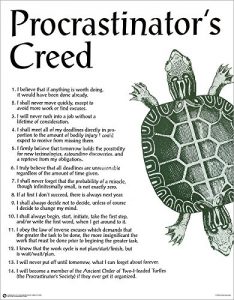
Old habits die hard.  In my case, they just never get around to dying at all.  See, one of my worst habits is procrastination.  I was given a poster in college called “The Procrastinator’s Creed” and I wasted no time whatsoever giving it prominent display in my dorm room.  It made me laugh, and still does to this day.  Laughter counts for a lot when you’re filled with regret over something you should have already done.


I continue to be a work in progress on this.  Self-induced positive reinforcement helps.  I make a conscious effort to start and finish projects early, and the feeling I have when I reach completion is so wonderful that I want to repeat it.  Negative reinforcement, not so much.  I’ve experienced migraines, panic attacks, marrow-level dread, and severe gastric distress all in response to looming deadlines that I “had plenty of time” to meet.  And I just keep doing it again and again.

Why is this so?  I’m far from being in the minority here.  Although it is most prevalent in student populations (some estimates are as high as 90%), it remains a problem for many far beyond their college years.  Perfectionism is a prime culprit; it’s very easy to stall on something when you doubt your ability to do it satisfactorily.  Avoidance of stress is another, but that beast rears its head hard when the deadline approaches.  It can be the result of factors such as ADHD or obsessive-compulsive tendencies, but we all know that that’s not the case for most of us.  Most of us just really don’t have any excuse.

So what to do?  Like anything else, you have to decide that it’s a problem, and commit to doing something about it.  Here are some things that you can do TODAY to start overcoming your habit of procrastination.

  • Be aware of habits and thoughts that lead to procrastinating.
  • Seek help for self-defeating problems such as fear, anxiety, difficulty in concentrating, poor time management, indecisiveness, and perfectionism.
  • Evaluate your own goals, strengths, weaknesses, and priorities.
  • Set realistic goals, and develop a personal positive link between the tasks and the concrete, meaningful goals.
  • Restructure activities of daily life.
  • Modify your environment for that newly gained perspective. For example, eliminate or minimize noise or distraction; put effort into relevant matters; reduce day-dreaming.
  • Discipline yourself to the priorities you set.
  • Motivate yourself with enjoyable activities, socializing and constructive hobbies.
  • Tackle issues in small blocks of time, instead of trying to solve whole problems at once and then be intimidated.
  • To prevent relapse, reinforce your pre-set goals based on needs and allow yourself to be rewarded in a balanced way for accomplished tasks.

Another big step is to figure out what your personal best time of day is (early bird? night owl?) and leverage your most high-functioning time accordingly to attack those tasks.  If you are feeling your best, both emotionally and physically, you have the confidence and energy to start, and persevere!

PS I committed to this for Christmas.  Look for my New Year’s submission eventually.  

The Eighty Twenty Phenomenon and Zipf’s Law in Life

December 5th, 2017

The of and to a in is I that it for you was with on as have but be they.

Right?  You may be scratching your head, searching for meaning in a sentence that seriously resists meaning altogether.  Relax.  It’s (almost) nonsense.  But the meaning is there.  As it turns out, these are the twenty most prevalent words in the English language.  The first word in the list appears five times as often as the fifth word, eleven times as often as the eleventh word, twenty times as often as the twentieth word, and so on.  This is called Zipf’s Law, and it applies to all sorts of things.  As it turns out, eighty percent of any given book, article, or other writing is made up of the top twenty percent of all words.

This eighty-twenty phenomenon starts to seep out into all different kinds of areas in our daily lives.

Eighty percent of customer complaints originate with twenty percent of the customers.

Eighty percent of land in the USA is owned by twenty percent of the population.

And…eighty percent of our results come from twenty percent of our efforts.

That’s right.  Eighty percent of what we accomplish in a given day, week, or year is due to only twenty percent of the work we put into it.  Think on that for a minute.  There’s more meaning there than you realize.  I would go so far as to say that eighty percent of our stress is due to only twenty percent of our experience, too.

The holiday season is in full swing now.  I live and work in a tourist destination, and Black Friday was as packed as I can remember.  It’s a wonderful place (that’s why I call it home), and I certainly understand the appeal.  That doesn’t make the traffic and the crowds any less challenging.  So I went home, put on some music, poured a glass of good wine, and enjoyed a delicious dinner.  I changed into my most comfy clothes, made brownies, and watched a movie with my son.  I took a long, hot shower and fell asleep reading a really good book.  And I woke up feeling like a new man.  Four hours of my life, just twenty percent of my day, gave me far more than eighty percent of the joy and peace that that day had to offer.

Take some time before the holiday craziness sets in.  Figure out which twenty percent it is that brings you the most happiness, and guard it with your life.  And after the ball drops on 2018, go forward with this in mind.  You may surprise yourself with just how much you’re capable of.

Of note: the, of , and and are the three most prevalent words that appear above.  There’s something you know now.

Language, Gratitude, and Hygge

November 17th, 2017

I’ve always harbored a deep fascination with language.  Both the use of it and the very nature of it.  To think that we can expel a stream of breath, interrupted and shaped by our throats and lips, and that the resultant thing we call “speech” somehow conveys meaning!  And never mind the extremely high-speed mentation that the listener undertakes to process those sounds to extract that meaning, craft a response and then with a single breath, respond.  LIke most things that we take for granted, it really starts to hurt the brain to think about it too much.  Studying French and Spanish threw a whole new wrench in the works:  the problem of translation.  As it turns out, many languages have words for things that require a sentence to convey in English.  And hygge is my new favorite by far.

Pronounced “hoo-guh” this Danish word is sorely needed for the Blue Ridge winter, and can be loosely described as “a quality of coziness and comfortable conviviality that engenders a feeling of contentment or well-being.”  The Norwegian word for “hug” is closely related, so sign me up.

Fuzzy blankets, crackling fires, and flickering candles.

Music, rich food, hot cocoa, and Irish coffees.

Friends & family, lovers, and the smell of bread in the oven.

The sheer overwhelming gratitude of it all.

Why don’t we have this word?  We need this word.  It really manages to cover all the best stuff in life. The things I work to be able to enjoy.  Yet, thirty-plus words of English still barely cover it.  I’m sure I could devote a hundred more, and still manage to only dance around it.

As it turns out, all language is kind of like this.  Words are imprecise.  What the speakers says differs from what the listener hears and the listener’s interpretation can end up at quite a remove from the original spoken intent.  Listen.  Think.  Ask questions.  Make an effort to truly understand.  Too often, we simply wait for the opportunity to speak.  We hear what we want to hear, elevate our belief to the level of truth, and react instead of respond.  Our public discourse is as contentious as I’ve ever seen it, and I feel that this is because we’ve become collectively too lazy-minded and inconsiderate to make the effort to understand our fellow travelers in this life.

In just a few days, many of us will gather with friends and family in what is meant to be a celebration of gratitude.  And when Uncle Jake finishes his fourth Irish coffee, and launches into his inevitable windbagathon about whatever social or political issue nobody wants to even think about, just take a deep breath.  Listen.  Think.  Remember that we all spin around on the same earth, and to a great extent all want the same things in life.  Be grateful that you have friends and family with whom you break bread.  Pour yourself some more wine, and radiate all the hygge you can muster.

Winning Against Daylight Savings Time

November 7th, 2017

Some years back, in my former life as a retail manager, I spent a beautiful spring week in sunny Los Angeles at a trade show.  I suppose it was beautiful…the vast majority of my time was spent on the floor of the convention center, and at the end of it all, the attendees were all very much in need of some good old-fashioned release.  After many hours of howling at the moon, and a couple of hours of barely restful sleep, I crawled out of bed and headed to the airport to return to the cold & rain that the mountains just never quite seem ready to let go of at the end of winter. And since too much is never enough, I had to contend with the fact that the morning that I tottered into LAX to catch that flight back to North Carolina was also the dreaded first morning of Daylight Savings Time. My most ever-needed hour of sleep on loan until November.

Spring forward. Spring. Clocks used to have springs, and mine was clearly broken.  And that’s how I learned all about jet lag.  Every morning was a struggle for the next week.  Cold, damp shadowless days under a sky the color of low-grade aluminum.  It took me the entire week to feel marginally human again. The extreme nature of this episode aside, every spring and every autumn, I still have to deal with something very much like jet lag.  And I’ve learned how to make it as painless as possible until the day that someone decides to to stop the madness, and leave the time alone forever and evermore.

My case was truly the perfect storm of circadian rhythm disruptions.  A week under artificial lighting with little to no actual sunlight (what a waste of a trip to California).  A night of Dionysian excess to wrap up my trip.  Five hours of canned air on an eastward flight across three time zones, with that extra bit of savagery from the clocks moving forward an additional hour. And nothing to greet me except more no sunlight.  Now the regular shifts back and forth between standard time and Daylight Savings Time may not be as bad as my ridiculous example, but they certainly manage to grind my gears all the same.

So what have I learned?  The first thing I learned is that there’s an upscale name for jet lag that all the cool scientists use: desynchronosis.  Set a personal goal to work that into casual conversation this week.  Your friends and coworkers will be impressed, and it’s current, with the clocks having changed and such.

Pro Tips:

Pro tip #1:  Breathe.  Studies have shown a correlation between low levels of environmental oxygen and susceptibility to jet lag.  Conversely, increasing your oxygen levels can go a long ways towards getting your internal clock back on track.

Pro tip #2: Drink up.  Not like I did before my flight.  Water, water and more water.  This is a good habit to get into anyway, so go ahead and do it.  Dehydration just makes everything worse.

Pro tip #3: Drink up (again).  This time, if caffeine is your thing, an early morning dose of it can increase alertness and tell your body that it’s morning, rewiring those circuits and getting you back more to a normal existence.

Pro tip #4:  Sunshine, sunshine, sunshine!  Exposure to direct sunlight is maybe the best way to get yourself back to normal in a hurry.  Your body can take subtle cues from its surroundings that help retrain that internal clock and bring everything back into line until the powers that be see fit to monkey with the time once again.

Pro tip #5: https://enddaylightsavingtime.org/sign-the-petition/

Make ahead breakfast recipes for those who hate mornings

September 26th, 2017
I hate morning. Like, hate it. I see why people love to get up early. It’s quieter, they can have a relaxed breakfast and then take care of business. Waking up in the morning is the most unnatural feeling to me. I imagine it’s a similar to the feeling babies have when they are born. You go from this warm, gentle, safe place to a bright, loud, demanding world.
There’s this thing that happens between early birds and night owls. Early birds think night owls are lazy when they sleep past 6am. The thing is, while early birds are sleeping at 9pm night owls are just getting started.  We get stuff done! Get off my back!  Sorry, I got off track.  I think that last little bit was directed at my husband.
Communicating, or worse cooking, before 9am is torture to me. I’ve cleverly found some ways to get my kid out the door in the morning with a healthier breakfast without much morning functioning on my part. Here are some easy breakfast tips that make me feel a little bit better about myself. Frosted Flakes are just fine in my house, but not every day.

Crustless Mini Quiches

I love this one. They are individual portions that can be made ahead of time, put in the freeze, and heated up in the microwave as needed.
Healthy, easy, and always ready when you’re on the go! I like to make these muffins at the beginning of the week, so they’re always on hand in the fridge or freezer. (Naturally gluten-free)
Author: Willow at Will Cook For Friends
Serves: 16-18 regular sized muffins

Ingredients

12 large eggs
½ cup heavy cream
¼ cup milk
2 TBSP fresh parsley, chopped
2 TBSP fresh basil, chopped (or other herb)
¼ tsp. salt
¼ tsp. pepper

Veggies*:
1 cup broccoli, cut into teeny tiny florets
1 cup fresh spinach, roughly chopped
¼-1/2 cup onion, diced fine
1 red bell pepper, chopped small
1 jalapeno pepper, seeds and veins removed, diced fine (optional)

Add-ins (optional):
1½ cups cheddar, gruyere, mozzarella, or other cheese, divided
1 lb. bacon, sausage, or other meat, fully cooked

Instructions
  1. If using meat (bacon, sausage, etc.), cook it fully first. Set it aside to cool, then cut into small pieces.
  2. Preheat oven to 375 degrees F., and thoroughly grease (butter, coconut oil, or non-stick spray) a muffin tin. (NOTE: I recommend using a non-stick muffin tin for even easier removal.)
  3. In a large bowl, whisk together the eggs, cream, milk, parsley, basil, salt, and pepper. Set aside.
  4. Get all your veggies diced up and ready to go. Optionally, you can saute your onion with a bit of olive oil to soften it up and take away some of its bite. Set aside and allow to cool.
  5. Add all the veggies to the bowl with the egg mixture, and stir to combine. Stir in half of the cheese, and all of the meat, if using.
  6. Using an ice-cream scoop or ¼ cup measure, scoop the mixture into the prepared muffin pan. Fill to about ¼ inch from the top, then sprinkle a small amount of reserved cheese over each. Place in the oven, and bake for 20-25 minutes, or until the egg is fully set and the cheese has just started to turn golden on top.
  7. Remove from the oven and let cool for 5-10 minutes before running a butterknife around each muffin, and gently removing from the pan. Enjoy while warm, or let cool completely before storing in an airtight container in the fridge. Leftovers can be reheated for several seconds in the microwave (time will vary depending on your microwave), or a few minutes in a preheated oven or toaster oven.
Notes
*Feel free to sub in whatever veggies you like, or have on hand. I used about 3-4 cups of chopped veggies in total, and wouldn’t suggest using much more, otherwise you won’t have enough egg mixture to go ’round.

Make Ahead Mason Jar Smoothies

I’ve never screwed the blender blade on to the jar. Instead I dump the mixture into my Ninja, blend it up, and put it back in the jar.
Ingredients

½ of a banana broken into pieces
About 1 cup of berries or fruit of choice
About 1 cup of milk of choice
Tsp sugar (optional)
1 TBS protein powder (optional)

Instructions
  1. Break up bananas and put about ½ in the bottom of each jar.
  2. Fill the jar with about a cup of fresh or frozen berries or fruit of choice.
  3. Freeze in Mason jars until ready to use.
  4. Screw off lid and fill up with milk of choice or water.
  5. Add sweetener or protein powder if desired.

Freezer Breakfast Quesadillas 4 ways

I make a bunch ahead of time and put them in the freezer. They can be warmed up in a toaster oven or microwave. Follow this link to four different recipes.
Freezer Breakfast Quesadillas 4 Ways
Ingredients
2 eggs
1 Tablespoon butter/cooking spray
2 large (8 inch) tortillas
1/2 cup shredded cheddar cheese
salt to taste
Optional Fillers
The Meat Lover: Add in 1-2 Tablespoons of each
bacon, cooked and diced
sausage, cooked, drained and chopped
ham, chopped
The Hawaiian: Add in 1-2 Tablespoons of each
pineapple chunks, well drained
ham, chopped
The Veggie Lover:
bell peppers, diced
onion, diced
mushrooms, diced
The Cheese Lover:
(reduce base cheddar cheese to 1/4 cup)
1/4 cup monterey jack cheese
1/4 cup shredded mozzarella cheese
Instructions
1.  In a small bowl, whisk the eggs and salt.
2. Coat a large skillet with cooking spray or 1 tablespoons of melted butter. Add eggs and cook, stirring over a medium heat until eggs are fluffy and set. Set eggs aside in a bowl.

Pancakes

My husband makes awesome pancakes for breakfast. He frequently makes batches and freezes them to be used during the week.  We put them in the toaster frozen and serve them up like we’re IHOP. This is his recipe of choice.
Recipe By:dakota kelly
“This is a great recipe that I found in my Grandma’s recipe book. Judging from the weathered look of this recipe card, this was a family favorite.”
Ingredients
1 1/2 cups all-purpose flour
1 tablespoon white sugar
3 1/2 teaspoons baking powder
1 1/4 cups milk
1 egg
3 tablespoons butter, melted
1 teaspoon salt
Instructions
  1. In a large bowl, sift together the flour, baking powder, salt and sugar.
  2. Make a well in the center and pour in the milk, egg and melted butter; mix until smooth.
  3. Heat a lightly oiled griddle or frying pan over medium high heat.
  4. Pour or scoop the batter onto the griddle, using approximately 1/4 cup for each pancake. Brown on both sides and serve hot.

Fall Festivals and Events from the City to the Mountains

September 21st, 2017

North Carolina is full of fall festivals and fun events! Here is a list of events from Charlotte to the High Country. Click links for additional information and please let us know if you have any favorites!

Charlotte Area

Downtown Hickory Art Crawl

Hickory September 21

Pennzoil AutoFair

Concord September 2124

The Sails Original Music Series

Hickory September 22 , September 29

Footcandle Film Festival

Hickory September 2224

Live Well Weekend

Belmont September 23 , September 24

Harvest Folk Festival

Catawba September 23

Lake Norman Beerfest

Cornelius September 23

Festival in the Park

Charlotte September  22-24

Great Grapes Wine and Food Festival

Charlotte September 30

American Hairless Terrier Dog Show

Hickory September 29 , September 30 , October 1

Carolina Renaissance Festival

Huntersville Saturdays & Sundays September 30 – November 19

Chinese Lantern Festival 2017

Belmont September 7October 29

Foothills Folk Art Festival

Newton October 7

32nd Annual Oktoberfest

Hickory October 1315

Lost Hollow Fall Music Fest

Belmont October 14October 15

Carolina BalloonFest

Statesville October 20-22

Bootanical

Belmont October 28October 29

High Country

Ghost Train Halloween Festival

Blowing Rock September 22September 23

Art on the Mountain

West Jefferson September 23

Thistle Meadow Winemaker’s Festival

Laurel Springs October 1

Art in the Park

Blowing Rock October 7

Sparta October 20October 22

Valle Country Fair

Valle Crucis October 21

40th Annual Woolly Worm Festival

Saturday October 21- October 22

Blowing Rock Halloween Festival

Blowing Rock October 28

Ashe Civic Center Music Concerts

West Jefferson November 3

Ashe County Little Theatre Performances

West Jefferson November 1719

How to prepare for a storm (without bottled water).

September 12th, 2017

8 million tons of plastic ends up in the ocean every year. No wonder the ocean is giving us the middle finger (aka hurricanes) right now. The amount of resources it takes to produce and deliver each bottle is astounding, fossil fuels are used to create the plastic and transport them to stores. Only one in five of those bottles are recycled.  Recycling uses fossil fuels and the other four end up in the ocean or landfill to sit for hundreds of years attempting to decompose. We’ve let marketing get in the way of common sense. So, here are some ways to prepare for storms without the waste. And even some tips that aren’t just about water.

Water

We’re fortunate enough to get plenty of warning before storms now.  To ensure that you’ll have enough drinking water start filling up jugs and food storage bags. The bags can be frozen and kept cold even if the power goes out. You can reuse those bags a different time. We’ve acquired one of these jugs from a family member, but any type will work.  One jug can avoid the cost and waste of bottled water. Fill your bathtub with water. The tub water can be used for drinking, washing, and flushing the toilet. If you have small children, please keep safety in mind if the bathtub is full.

Electronics and flashlights

Fully charge all of your electronics. This includes cell phones and reusable batteries for flashlights. One of my favorite items, while expensive, is the Goal Zero Mini Lantern. This thing is BRIGHT.  On it’s lowest setting it can provide light for up to 500 hours. You can also use it with a USB cable to charge phones. The larger version has a hand crank and solar panel to keep it powered. Make sure flashlights and batteries are easily accessible.

Food

Stock up on nonperishable food items. Canned foods, granola bars, trail mix, peanut butter, and crackers are good choices.

Medication

Have all of your prescription medication is filled before the storm hits.  All states have their own laws, but typically you can get a 30 day supply of your medication if you’re in an area that is under an evacuation order.  Keep the medication, along with other first aid items, in a bag that you can grab if you need to leave quickly.

Pets

Be sure you have plenty of food and medication for your pet before the storm. Research shelters that will take your pet temporarily if you have unable to evacuate with them. Many hotels and vacation rentals will make accommodations for evacuees with pets. Ask and have a game plan in place ahead of time. If you’re pet is unfortunate to be tethered up outside, please have a heart and bring them inside, take them with you if you leave or let them free.  Pets who are tied up don’t stand a chance.

Documents

Place all of your important documents in a watertight bag. This includes driver’s license, photo ID, birth certificates, passports, emergency contacts, insurance policies and wills.

Home

Preparing your home depends on where you live and what type of storm you’re expecting. No matter what, it’s important to review your homeowners insurance policy. Consider purchasing flood insurance if you’re in an area at risk. Seal windows, remove furniture from the yard and porches, and be sure roof is secure. If you have a generator check to see if it’s in working condition. Don’t be like my family. We have a generator that we don’t think about until we have no power. It sits in our shed in disrepair while we sit in the dark.

Stay safe and take care of each other. Please let us know if you have any other useful tips!


[idx-omnibar styles="1" extra="0" min_price="0" ]