Old habits die hard. In my case, they just never get around to dying at all. See, one of my worst habits is procrastination. I was given a poster in college called “The Procrastinator’s Creed” and I wasted no time whatsoever giving it prominent display in my dorm room. It made me laugh, and still does to this day. Laughter counts for a lot when you’re filled with regret over something you should have already done.
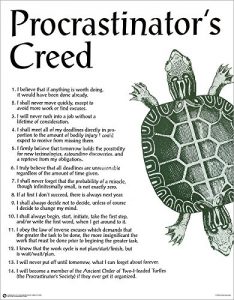
I continue to be a work in progress on this. Self-induced positive reinforcement helps. I make a conscious effort to start and finish projects early, and the feeling I have when I reach completion is so wonderful that I want to repeat it. Negative reinforcement, not so much. I’ve experienced migraines, panic attacks, marrow-level dread, and severe gastric distress all in response to looming deadlines that I “had plenty of time” to meet. And I just keep doing it again and again.
Why is this so? I’m far from being in the minority here. Although it is most prevalent in student populations (some estimates are as high as 90%), it remains a problem for many far beyond their college years. Perfectionism is a prime culprit; it’s very easy to stall on something when you doubt your ability to do it satisfactorily. Avoidance of stress is another, but that beast rears its head hard when the deadline approaches. It can be the result of factors such as ADHD or obsessive-compulsive tendencies, but we all know that that’s not the case for most of us. Most of us just really don’t have any excuse.
So what to do? Like anything else, you have to decide that it’s a problem, and commit to doing something about it. Here are some things that you can do TODAY to start overcoming your habit of procrastination.
- Be aware of habits and thoughts that lead to procrastinating.
- Seek help for self-defeating problems such as fear, anxiety, difficulty in concentrating, poor time management, indecisiveness, and perfectionism.
- Evaluate your own goals, strengths, weaknesses, and priorities.
- Set realistic goals, and develop a personal positive link between the tasks and the concrete, meaningful goals.
- Restructure activities of daily life.
- Modify your environment for that newly gained perspective. For example, eliminate or minimize noise or distraction; put effort into relevant matters; reduce day-dreaming.
- Discipline yourself to the priorities you set.
- Motivate yourself with enjoyable activities, socializing and constructive hobbies.
- Tackle issues in small blocks of time, instead of trying to solve whole problems at once and then be intimidated.
- To prevent relapse, reinforce your pre-set goals based on needs and allow yourself to be rewarded in a balanced way for accomplished tasks.
Another big step is to figure out what your personal best time of day is (early bird? night owl?) and leverage your most high-functioning time accordingly to attack those tasks. If you are feeling your best, both emotionally and physically, you have the confidence and energy to start, and persevere!
PS I committed to this for Christmas. Look for my New Year’s submission eventually.